The match ends, Celesta takes over.
We write the show months before the match, without knowing the result: we prepare the possible outcomes, arm the set-up and launch it on a cue from the control room.
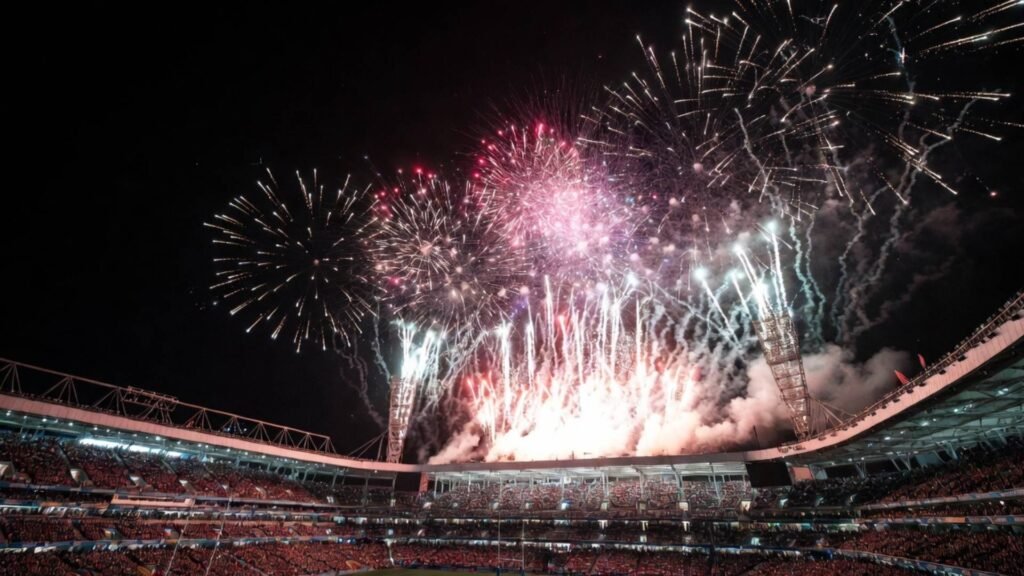
Months of preparation and the last fifteen minutes.
At a sporting event, we set part of the show months ahead, in the office, and decide the rest in the last fifteen minutes.
Set months before the match
- The layout of the shooting positions, as recorded by Celesta on site
- The regulatory dossier and its examination
- The soundtrack and the frame-by-frame sequence
- Equipment, teams and access
- The possible outcomes, each written out in full
Decided in the last fifteen minutes
- The actual departure time, which remained unknown right up to the last moment
- The version chosen in light of what has just happened
- The duration, adjusted to the audience remaining in the stands
- The wind, measured one last time before the agreement
- The go-ahead, given by production control and by no one else
Clubs, federations, organisers and broadcasters.
We work with all four and adapt the set-up to whoever makes the decision.
01
Clubs and teams
Whether it’s the opening match, a gala evening, a centenary, promotion or the title: the date is set, but the outcome is not. We’re preparing for both possible outcomes and making sure we’re ready for either one.
02
Federations and governing bodies
Opening or closing of a competition, trophy presentation, official protocol: we time the show to the minute and the order of precedence of the ceremony.
03
Organisers and agencies
You are organising the event on behalf of a third party and are fully accountable to them. We will be listed on your running order as just another item, with our set-up times and a contact person who can be reached.
04
Broadcasters and partners
We synchronise the choreography with the broadcast window and the camera angles, then with the stands, so that the partner’s brand appears on screen.
Six constraints specific to stadiums.
We note them at the site survey, before writing.
01
The pitch and the playing area
It cannot take load, hot fallout or marks. The set-up sits around the edge, in the stands or on the roof, and we write from this constraint.
02
An uncertain timing
Extra time, stoppage time, a trophy presentation that drags on: we do not rely on the announced time. The set-up stays armed and watched, sometimes for more than an hour.
03
The audience is already on their feet
The crowd has just come out of a match. So we shorten the duration and build the intensity faster.
04
The broadcast and the cameras
For a broadcast event, we set the show for the camera as much as for the stands. Pace, backlight, camera angles: we prepare the result with the TV director before the day.
05
The stadium regulations
A stadium is a venue open to the public, with its own rules and regulations, its own head of emergency operations and its own safety committee. We put the application together with them.
06
The partner wants their image
A logo in the sky, the club’s colours, a brand message: these requests come late and change the writing. We build them into the story.
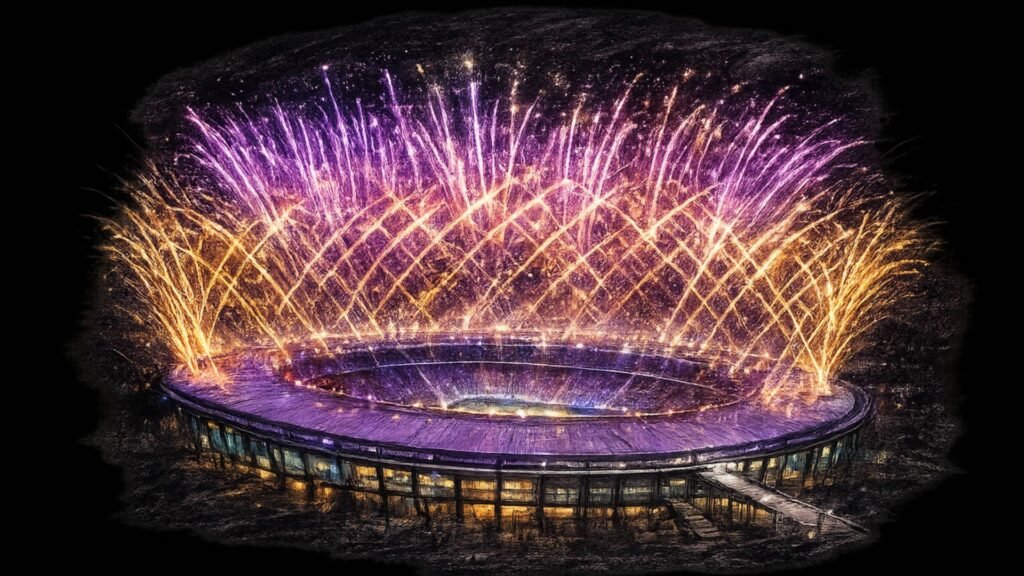
The season’s fixture list at the top of the production control team.
Six stages, only one of which the audience sees.
01
The season
The date sits in a sports calendar that can move. We work on a window of dates and plan for postponement from the first meeting.
02
Location
We visit the site with the operator: distances, access, anchor points, areas closed to the public. We write the show from this survey.
03
Writing
The sequence is synchronised frame by frame with a soundtrack. The possible outcomes are written separately: they share the same equipment and each has its own running order.
04
The file
Prefecture declaration for a fireworks display, DGAC filing for a drone flight. We prepare the application; the organiser remains the applicant and signs.
05
The rehearsal
We rehearse the timing: the launch procedure with the control room and the announcer, and switching from one version to the other.
06
The signal
Come evening, everything is set up and under surveillance. The signal comes from the field. Less than three seconds pass between the order being given and the first glimmer of light.
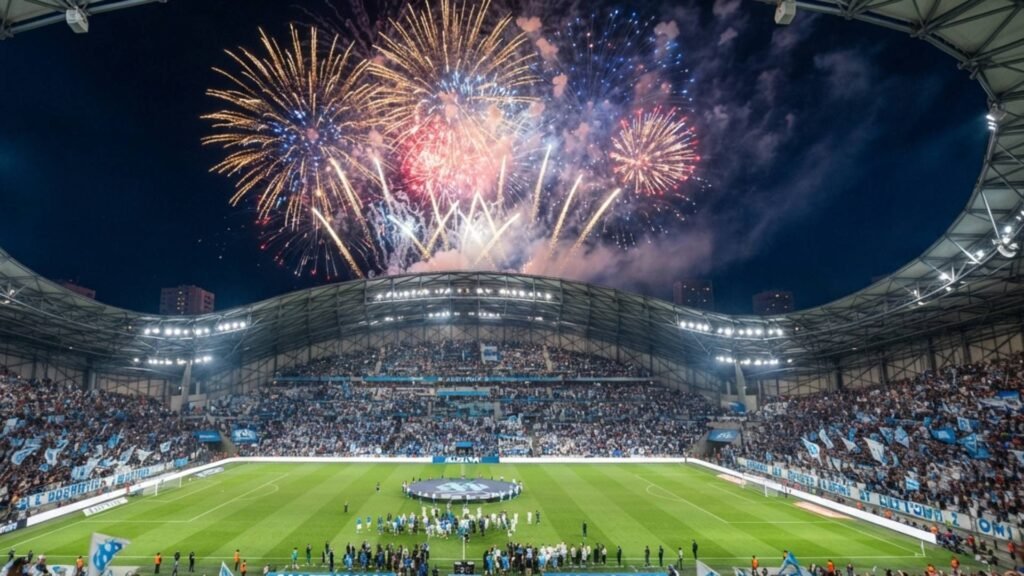
A short show, after the match.
The audience came for the match. We launch the fireworks afterwards, on an emotion already there, to extend it by a few minutes.
That is why we write short and intense, and why the launch is not negotiable: fifteen seconds late in a stadium that is emptying, and the show plays to half-empty stands.
Lead times and price of a stadium show.
Four minimums and one threshold, valid whatever the competition.
Orders of magnitude
per event
Costed proposal
within 48 hours
A bespoke show
3 to 6 months
Permission to set off a fireworks display
At least 1 month
Authorisation for a drone flight
A minimum of 45 days
On-site survey
systematic
Drone light show, from
€10,000
48 h
A costed proposal
As soon as the schedule and venue are known
F4
In-house pyrotechnicians
The qualification required for shooting in front of an audience
DGAC
Reported thefts
An airspace application is submitted for each drone show
+20
Countries of operation
France, Europe, the Middle East and Asia
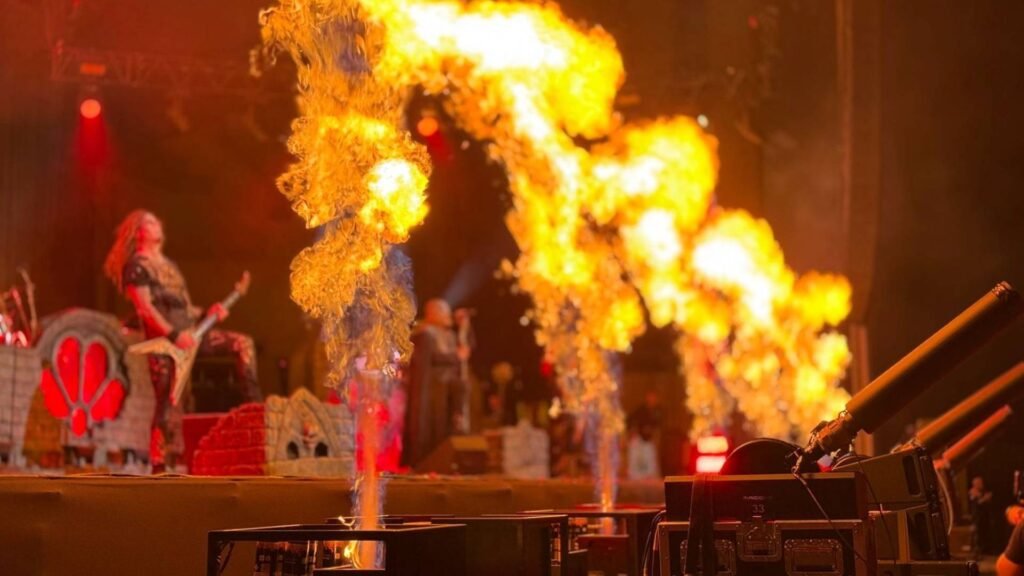
Present your competition.
A final, a lap of honour, a competition opening: tell us the venue, the date window and the aim. We reply within 48 hours with a first costing and the constraints already identified on your site.
Your questions about sporting events.
How do you start the show if the match goes into extra time?
The launch is not programmed on a clock but on a signal. We agree a cue procedure with the control room, given by the TV director or the announcer, and the set-up stays armed and watched until that order. A fallback window is always written in case the signal does not come.
Can we put anything on the lawn?
As a rule, no: the playing area is an asset protected by the competition rules and often by contract. The set-up therefore sits around the edge, in the stands, on the walkways or on the roof.
How long should you allow for a final?
Allow 3 to 6 months for a bespoke show. On top of this, there are administrative lead times, which run in parallel but are separate from the creative process: a minimum of 1 month for a fireworks display, and a minimum of 45 days for a drone light flight.
Is it possible to hold a performance in an indoor venue?
Yes, with a different palette. Cold stage effects, calibrated flames and indoor drone flights can be deployed under a roof as long as the volume and height allow. The site survey decides.
What happens if the result isn’t what we’d hoped for?
It is planned for. The outcomes are written separately and share the same equipment: only the running order changes, and we switch it in the control room. This switch is rehearsed before the day and cannot be seen from the stands.
Who is granted authorisation?
Celesta puts together the technical dossier and submits the applications: a prefecture declaration for a firing exercise, the AlphaTango application to the DGAC, and a risk assessment for a drone flight. The organiser remains the applicant and signs the documents; they do not need to compile the dossier.