Celesta, service provider living heritage.
A château courtyard, a nave, a forecourt, a quarry, a listed park: almost none of these places was designed to host a night-time show. We write from the survey of each venue.
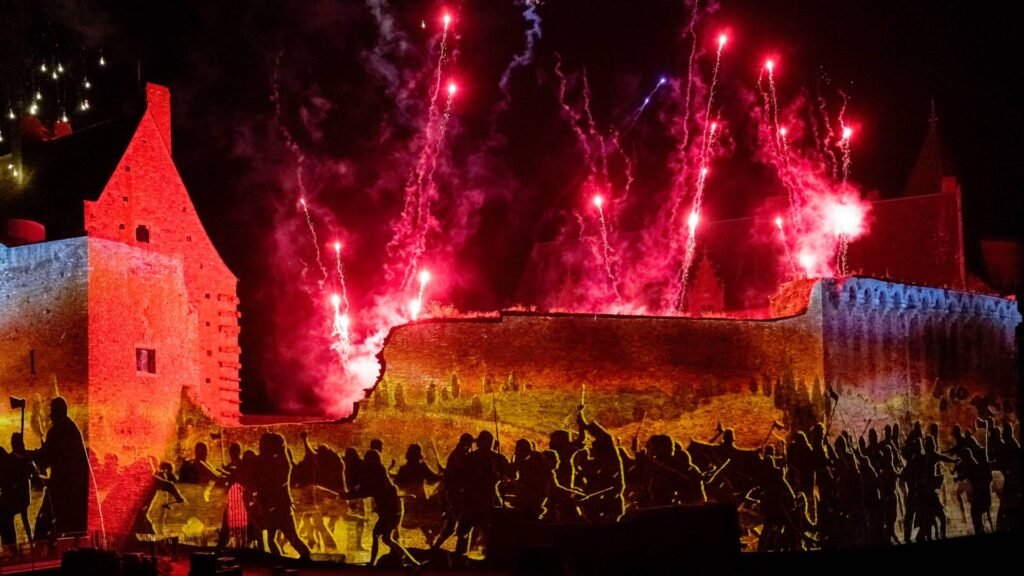
Performance venue and heritage site.
In a theatre, rigging, power and evacuation are provided by the building. On a heritage site, we negotiate each of them with the site manager.
In a room
The equipment provided by the venue
- Pre-fitted and loaded anchor points
- Available electrical power at the workstation
- A full black achieved in a single pass
- Emergency exits sized to meet the capacity requirements
- A stage manager who is already familiar with the venue
On a website
Points negotiated with the site manager
- Each support point, agreed with the manager
- Energy, often supplied and soundproofed
- Black, which depends on nearby street lighting
- People walking on uneven ground
- The cut-off time, set by ministerial order rather than by the notice
Six constraints of a heritage site.
We note them at the site survey, before any writing.
01
The material of the frame
Limestone, slate, brick, old timber framing: each material has its safety distance and heat tolerance. We choose the products accordingly.
02
The administration’s perspective
On a protected site, the agreement is prepared with the site manager and, depending on the listing, with the Architecte des Bâtiments de France. This dialogue starts months in advance.
03
The resident who is asleep
The by-law sets the curfew and the permissible sound level. We calculate the sound level of a display before writing it, and settle the noise question at the site survey.
04
Switching off the street lighting
A streetlight, a sign or a nearby car park are enough to wipe out a scene. We ask the local council to switch off the lighting and write it into the sequence as an effect in its own right.
05
The audience is very close
In a courtyard or on a forecourt, we cannot move the audience back: we gain the safety distance through cold effects, height, orientation, and a perimeter we draw with the venue.
06
Restoring the site
Fallout, markings, turf, gravel: the restoration work is checked point by point with the site manager, and this determines whether authorisation will be granted for the next event.
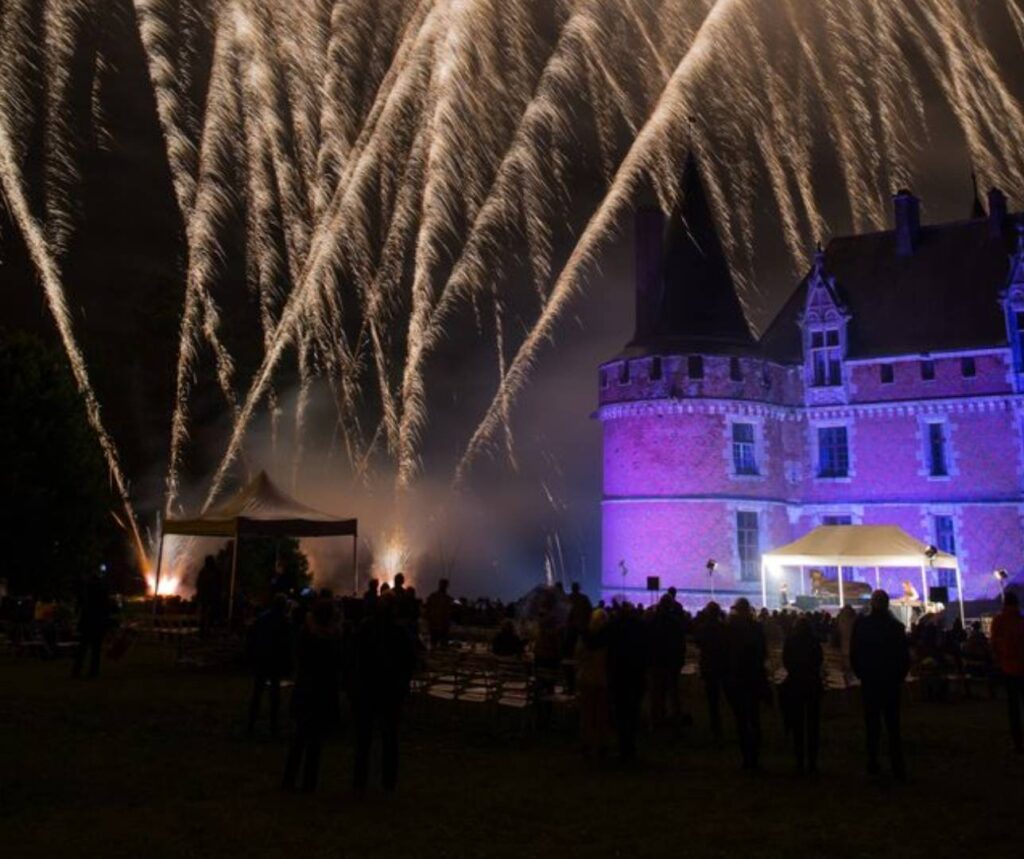
Site survey for refurbishment.
The performance is only the fifth of these six stages.
01
Location
We visit the site with its manager: materials, bearing points, buried networks, fire access, neighbours. We write the show from this survey.
02
Writing
The story is built from the site’s architecture and history, set to the time-code.
03
The instruction
Prefecture declaration, the property manager’s approval, consultation with the Architecte des Bâtiments de France if the site requires it, and submission of an application to the DGAC for drone flights.
04
The editing
Five to eight hours on site, with protective measures put in place before any equipment is brought in. We place a protective layer between each point of contact and the stone, and photograph each one before and after.
05
The performance
The launch is set to the second, planned months earlier. We run the control desk and remain the venue’s single point of contact throughout the show.
06
Restoration
Monitoring of fallout, clean-up, and a joint inspection report with the site manager.

Festivals, concerts and cultural projects.
A festival, a concert and a cultural project do not share the same schedule, the same sponsor or the same venue constraints. We apply the same method to each, from the site survey to the restoration of the site.
Each format has its own page, with its specific constraints and projects: festivals, where the show fits into a programme written by others; concerts and shows, set to the time-code of the live performance; cultural projects, where the work or the venue drives the story. We design, produce and run all three with no intermediary.
Lead times and price of a heritage show.
Four minimums and one threshold, valid whatever the site.
Orders of magnitude
on a per-performance basis
Costed proposal
within 48 hours
A bespoke show
3 to 6 months
Permission to set off a fireworks display
At least 1 month
Authorisation for a drone flight
A minimum of 45 days
On-site survey
systematic
Drone light show, from
€10,000

Present your venue.
A courtyard, a façade, a park, a nave: send us the address, the date window and the aim. We reply within 48 hours with a first costing and the site constraints already identified.
Your questions about culture and heritage.
Is it allowed to set off a fireworks display above a listed monument?
Yes, but the medium changes. Distances, heights, products and anchor points are agreed with the site manager. That is why we survey each venue before writing.
Is approval from the Architecte des Bâtiments de France required?
It depends on the listing and the nature of the set-up. As soon as an anchor, a structure or a projection touches the building or its protected surroundings, consultation is required. We prepare the documents and support the organiser through the process.
How is the venue secured during the performance?
Through interfaces installed before any materials are laid, a photographic record of the site before and after, and a perimeter calculated to ensure that no hot fallout falls onto the building structure. The final inspection is carried out with the site manager, point by point.
Is it possible to stage a performance indoors, beneath a nave?
Yes, with a different palette: cold effects, heavy fog, lighting and sound, and drone flights as long as the volume and vault height allow. The site survey decides.
How long should a cultural season last?
Allow 3 to 6 months for a bespoke show. On top of this, there are administrative lead times, which run in parallel without overlapping with the creative process: a minimum of 1 month for a fireworks display, and a minimum of 45 days for a drone light flight.
What happens if a drought order is issued?
The prefect can ban any fireworks display. So we write each scenario with its fallback: switching to a version with no hot fallout, more lighting and drones, or a supervised postponement. The decision lies with the competent authority.