Celesta, fireworks and drones for festivals.
A field, a brownfield site, a park become a town of several thousand people, then disappear. Power, access, barriers, ground: everything is temporary and set up by others. We install our set-up within this temporary infrastructure.
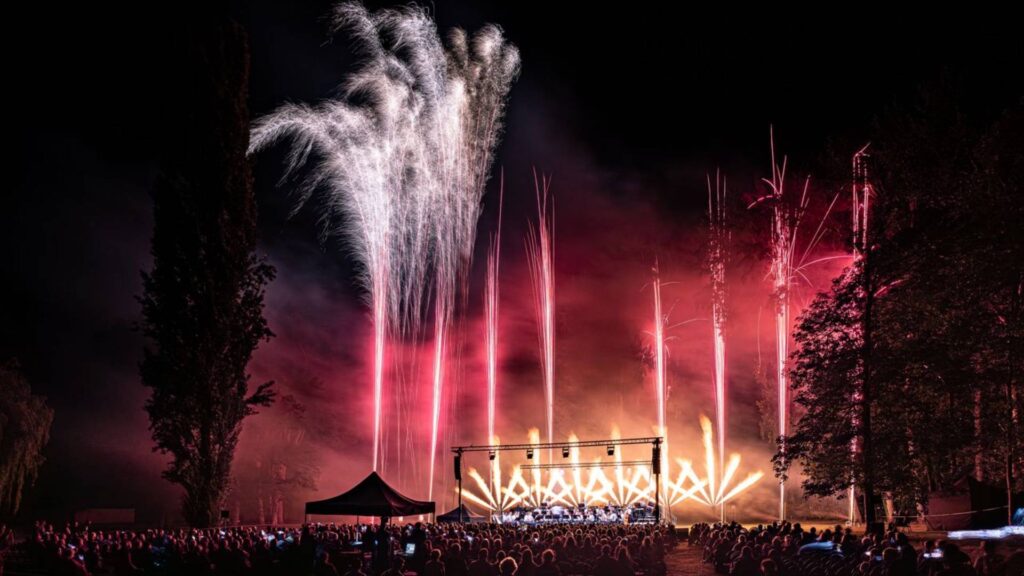
A temporary site, changing until the day before.
At a festival, we survey a site plan that will still move, and our method adapts accordingly.
At a permanent site
The givens of a permanent venue
- A stabilised subgrade with a known bearing capacity
- Fixed points identified once and for all
- A suitably sized power supply
- Permanently marked fire access routes
- A boundary that nobody moves
At a festival
The variables of a festival site
- A ground that changes with the week’s rain
- A site plan that had been amended yet again the day before
- Generators shared with the stage
- Emergency routes redesigned for each edition
- A campsite and lodges within the operational area
Six constraints specific to festivals.
We note them on the ground, before writing.
01
Ground bearing capacity
A waterlogged meadow cannot carry a weighted mortar or a lorry. We check the load-bearing capacity and plan track panels with you before choosing the layout.
02
Energy is shared
The bands are already powering the stage, the production control room and the catering facilities. A late request has meant that an extra band has to be added, which means more fuel, more noise and extra space on the ground.
03
The safety perimeter and the capacity
Every metre we reserve for the safety perimeter is taken from the audience area. So we open the discussion with the production very early on.
04
The neighbourhood has a curfew
The prefectural order sets the closing time, and this cannot be negotiated on the evening in question. We write the display that follows the final concert so that it fits within this time slot.
05
The campsite is within the perimeter
At many editions, festival-goers sleep a few hundred metres away. We calculate the fallout zone with them in mind, and the evacuation is prepared with security.
06
Handing back the ground and the next edition
We leave the ground clean and respect the authorisation point by point: the festival’s return the following year depends on it.
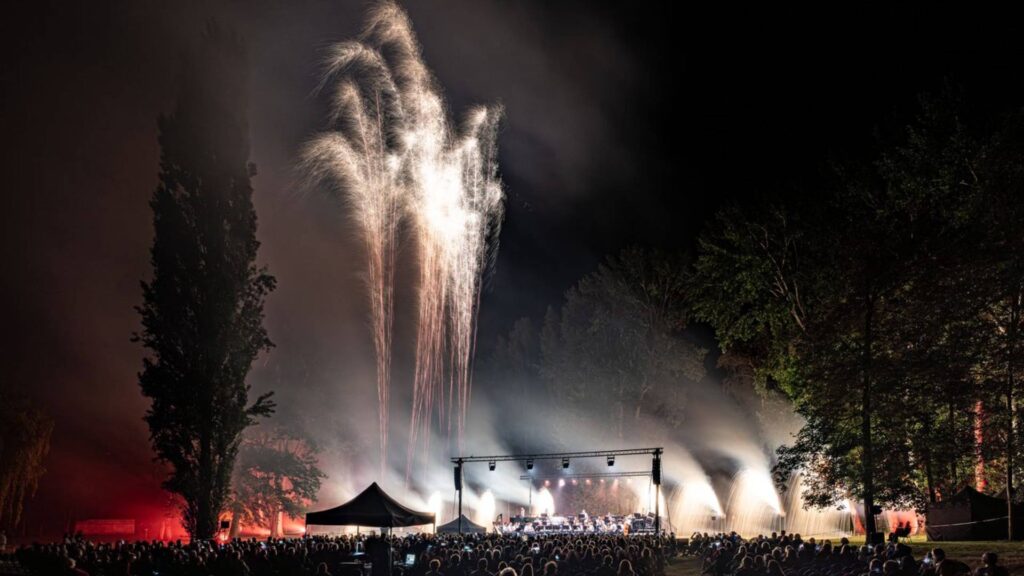
Site plan upon handover of the land.
The display is only one of these six stages.
01
The site plan
We join the project when the production is drawing the site. This lets us reserve the firing zone while the plan can still accommodate it.
02
Location
Visit of the bare ground with the general stage manager: load-bearing capacity, buried networks, trees, power lines, neighbours.
03
Writing
The running order is set to the actual programme and the curfew. We write it short.
04
The file
Prefecture declaration, safety commission opinion, DGAC filing for a drone flight. We prepare the application, the organiser signs.
05
The editing
Five to eight hours on a site already occupied by twenty other trades. We set up alongside them, and access stays clear.
06
The handover
Dismantling, monitoring of fallout, complete clearance, and a final inspection with the landowner.
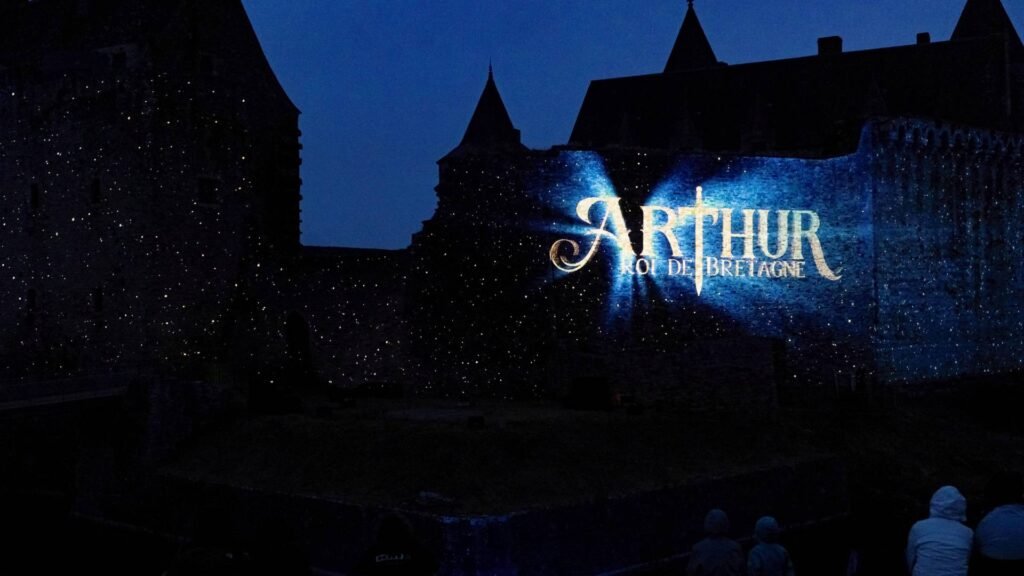
A short festival display, set right after the headliner.
The audience in front of our display has been walking, waiting and dancing, and still has to make its way back to a tent or car.
That is why we write short, dense sequences, and why the launch is set as close as possible to the last chord. We prefer a six-minute display straight after the headliner to a twelve-minute display announced twenty minutes later, in front of a site that is already emptying.
Lead times and price for a festival.
Four minimums and one threshold, valid whatever the audience size.
Orders of magnitude
per edition
Costed proposal
within 48 hours
A bespoke show
3 to 6 months
Permission to set off a fireworks display
At least 1 month
Authorisation for a drone flight
A minimum of 45 days
Survey of the vacant plot
systematic
Drone light show, from
€10,000
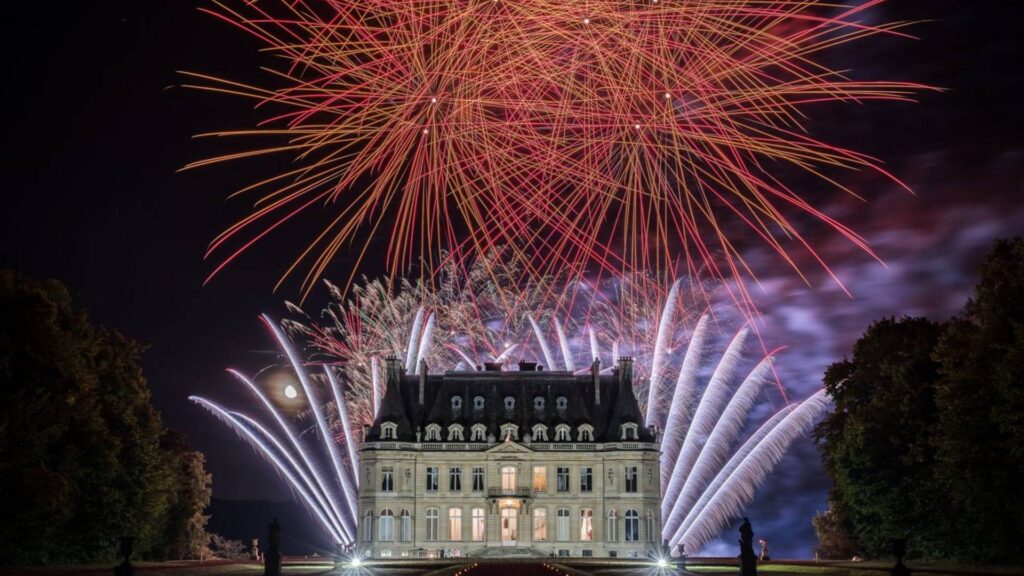
Send your site plan.
An opening, a closing, a highlight mid-edition: tell us the site, the dates and the planned programme. We reply within 48 hours with a first costing and the ground constraints already identified.
Your questions about festivals.
Can you shoot if the ground is waterlogged?
Yes, provided it has been planned for. We check the load-bearing capacity at the site survey and plan suitable track panels and ballast. We also prepare a fallback solution for ground found waterlogged the day before.
Do we need an extra generator?
Rarely for pyrotechnics, which run on batteries. More often for drone light flights or scenography. The cost is calculated during the initial discussions so that it can be included in the festival’s energy budget.
How many metres do we lose on the gauge?
It depends on the calibre and the nature of the site. A close-range display with cold effects needs very little, an aerial shell much more. We always offer several scenarios costed in metres, so that the decision is made with full knowledge.
Can the show go on after the cut-off time?
No. The end time set by the by-law is a regulatory limit. The running order is therefore written to fit within the window, with a shortened version ready if the programme overruns.
What happens if a drought order is issued?
The prefect can ban any fireworks display. We write each scenario with its fallback: switching to a version with no hot fallout, more lighting and drones, or a supervised postponement. The decision lies with the competent authority.
How long should you allow for a first edition?
Allow 3 to 6 months for a bespoke show. On top of this, there are administrative lead times, which run in parallel but are separate from the creative process: a minimum of 1 month for a fireworks display, and a minimum of 45 days for a drone light flight.